
The Mystic Silenced for Thirty-Eight Years — Dominican Tertiary, Stigmatist of Viterbo, Foundress of the Convent of Saint Catherine of Siena in Ferrara (1476–1544)
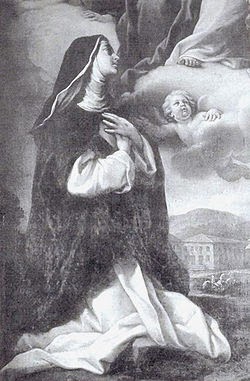
Lucy Brocadelli did nearly everything the Church asks of a faithful woman, and for most of her life she was punished for it by the Church's own people.
She heard God's call as a small child and held to it through a forced marriage. She left comfort and rank to live in poverty. She endured public examination of the wounds she bore, and she accepted a duke's invitation to found a convent. And when the duke who protected her died, the sisters she had gathered around her turned on her. For nearly forty years she was shut away in her own foundation, forbidden to speak with almost anyone, treated as though she had somehow disgraced the community she had built. Many of the sisters, it is said, were surprised to learn when she died that she had still been alive.
If you have ever given years of your life to a parish, a family, a religious community, or a cause, and then found yourself pushed to the margins by the very people you served, Lucy is a companion who has been there. She did not respond with anger, and she did not leave. She prayed, and she waited. The Church that had silenced her did not forget her. When she died, the people of Ferrara came by the thousands, and the funeral had to be delayed for three days to let them all pass by her coffin.
An Umbrian Girl in the Age of the Borgias
Lucy was born on December 13, 1476, in Narni, a hilltop town in Umbria, about fifty miles north of Rome. It was the feast day of Saint Lucy of Syracuse, and her parents named her accordingly. She was the eldest of eleven children of Bartolomeo Brocadelli and Gentilina Cassio, a respectable family of the local gentry. The town's Roman name was Narnia, which is why, in English, she is sometimes called Lucy of Narnia.
The Italy she grew up in was a country of extraordinary beauty and extraordinary corruption. This was the Renaissance, the age of Leonardo and Michelangelo, but it was also the age of the Borgias. In 1492, when Lucy was fifteen, Rodrigo Borgia was elected pope as Alexander VI, and the court of Rome became notorious for ambition, money, and scandal. Meanwhile, in Florence, a Dominican friar named Girolamo Savonarola was preaching fiery sermons against corruption in the Church and the city, and drawing both devoted followers and bitter enemies. Italian city-states fought each other constantly. French armies were crossing the Alps.
It was a world in which a serious young woman who wanted nothing but God could find very little around her to encourage her.
The Child Who Saw Mary
Lucy's religious life began extraordinarily early. According to the tradition, when she was five years old, she saw a vision of the Virgin Mary. Two years later, at seven, she saw Mary again, this time accompanied by Saint Dominic, who is said to have given her a scapular, the sign of belonging to the Order of Preachers.
We should be careful with accounts like this. They come from pious biographies written long after the fact, and the Church does not require anyone to believe a particular private vision (Catechism of the Catholic Church, 67). What we can say is that from her earliest years, Lucy was a child of intense prayer, and that she attached herself in her heart to the Dominicans.
At twelve, she made a private vow of chastity and resolved to become a Dominican nun.
Then her world fell apart. Her father died the following year, and she was left in the care of an uncle. The uncle had his own idea of what to do with a girl of thirteen with a vow she had told almost no one about. He decided to marry her off as quickly as possible, which, to be fair to him, was also what her father had wanted before he died.
The Slap and the Compromise
The uncle's first attempts at matchmaking did not go well. He staged a large family party and invited a suitor he had chosen, intending to have the couple publicly betrothed on the spot. He did not tell Lucy. When the young man tried to put a ring on her finger, she slapped him, more than once.
Whatever one thinks of the manners involved, it was a clear statement. But the uncle did not give up, and a second candidate was more difficult. Count Pietro di Alessio, of Milan, was a family acquaintance, and Lucy, by all accounts, was fond of him. That was the problem. She liked him, she could have been happy, and she had made a promise to God. The conflict between what she wanted and what she had vowed made her seriously ill.
During this illness, the sources say, the Virgin Mary and Saint Dominic appeared to her again, this time with Saint Catherine of Siena, the great Dominican mystic who had died a century earlier. They advised her to go through with the marriage, but with a condition: she was to tell Pietro plainly that her vow of virginity would have to be respected.
Pietro agreed. In 1491, at the age of fourteen or fifteen, Lucy became his legal wife.
A Countess Who Fed the Poor
For the next three years, Lucy lived as the mistress of a noble household, with servants to supervise and a busy social calendar to keep. By all accounts, she handled it. She was gracious to guests. She taught the servants their prayers. She became known in the neighborhood for her charity to the poor.
At night, her life was something else. She wore a hair shirt under her clothes and spent long hours in prayer. The servants whispered that she was visited in the evenings by Saint Catherine, Saint Agnes, and Saint Agnes of Montepulciano, who helped her bake bread for the poor.
Pietro, to his credit, was remarkably patient. He did not object when she gave away food and clothing. He did not object to her penances. He had agreed to the terms of the marriage, and for a long time he kept them. But a husband can be pushed too far, and it was a servant who pushed him.
One day, a servant came to him and told him that Lucy was entertaining a handsome young man in private. Pietro grabbed his sword and went to find the man. What he found was his wife kneeling alone before a large crucifix. The servant, puzzled, insisted that the man he had seen with her looked just like the figure on the cross.
That was the beginning of the end. Not long after, Lucy slipped out one night to a Franciscan friary, found it closed, and returned the next morning. She said that two saints had led her back. This was too much for Pietro. He had her shut up in the house for most of Lent, with only servants bringing her food.
Escape, and a Fire
At Easter, Lucy escaped and went to her mother's house. On May 8, 1494, she received the habit of the Dominican Third Order, the lay branch of the order, whose members could live in the world or in community under a simple rule.
Pietro's reaction was violent. He burned down the monastery of the prior who had given her the habit.
We should hold this moment with a certain honesty. This was a man whose wife, whom he had treated with remarkable patience, had left him. By the standards of his time, he had every legal right to her. The Church has long taught that a person's call to the religious life is real and must be respected, and Lucy had been honest with him from the start. But Pietro was not a villain in a story. He was a husband who had lost his wife, and his grief and anger, however wrongly expressed, were human.
The story has a surprising ending. When Pietro came to see her once more, in a final attempt to win her back, she declined, and he left alone. He eventually became a Franciscan friar, and a well-known preacher. Whatever he had been in his anger, he found his way to God as well.
Viterbo, and the Marks of the Passion
In 1495, Lucy went to Rome and joined a group of Dominican tertiaries living in community. The next year, she was sent to Viterbo, north of Rome, to help establish a new convent. And it was there, according to the tradition, on February 25, 1496, that she received the stigmata, the wounds of Christ's Passion, on her hands, feet, and side.
She did her best to hide them. But news travels fast, and Viterbo soon filled with the curious and the devout. People came to speak with her. Others came simply to stare. She fell often into ecstasies, and during some of them, she seemed to relive the Passion. At one point, the sisters, who were concerned and unsure, called the local bishop, who watched her go through the Passion for twelve hours straight.
The bishop did not want to judge the case alone. He called in the Inquisition. The accounts of what happened next vary. Some say that the case went to Rome and that the pope, Alexander VI, spoke to her himself and, with the help of another Dominican tertiary mystic, Blessed Columba of Rieti, decided in her favor. Other sources doubt that this is the whole story. What is clear is that Lucy was examined, and that she came through.
The Church has always been careful in these matters. Saint Paul wrote that he bore on his body "the marks of Jesus" (Galatians 6:17), and the Church has recognized, in some saints, wounds that seem to share in the Lord's suffering. But the Church has never made belief in any particular stigmatist a matter of faith, and the real test is the fruit: humility, obedience, charity. In Lucy's case, the fruit was clear.
A Duke's Convent
While Lucy was in Viterbo, a powerful figure was watching her from afar. Ercole d'Este I, the Duke of Ferrara, one of the wealthiest and most cultured princes in Italy, had decided to build a convent in his city. He had heard of the stigmatic of Viterbo, and he wanted her to be its prioress.
In the summer of 1497, he formally invited her. Lucy, the Dominican Order, and the pope all agreed. The people of Viterbo did not. They had no intention of giving up the holy woman who had made their town famous, and their city council objected. For two years, Viterbo and Ferrara argued over her with letters, petitions, and diplomatic pressure.
Lucy herself had been praying for a way to found a community of stricter observance, and she wanted to go. On April 15, 1499, she escaped secretly from Viterbo. On May 7, she was received in Ferrara.
Thirteen young women applied to join her community almost at once. Construction began in June, and the convent was completed in August 1501. It was built to hold 140 cells, an enormous building, but filling it with real vocations proved difficult.
Lucy wanted some of her old friends from Viterbo and Narni to come. The Duke wrote to Rome, and the request reached the pope's own daughter, Lucrezia Borgia, who was about to travel to Ferrara to marry the Duke's son, Alfonso. Lucrezia collected eleven women Lucy had named and sent them ahead as a kind of wedding present for the Duke and the prioress. She herself entered Ferrara on February 2, 1502.
It is a strange and rather wonderful picture: the most notorious young woman in Italy, escorting a group of Dominican tertiaries to a convent founded by a stigmatic.
For a short time, Lucy had everything she had wanted: a community of strict observance, a powerful patron who respected her, and a place to pray. It did not last.
The Veiled Sisters
The trouble began with an act of well-meant help. The Duke asked the local bishop to send experienced nuns to assist Lucy in governing the new community. The bishop sent ten women from another monastery. They were members of the Dominican Second Order, canonical nuns who were allowed to wear black veils. Lucy and her sisters, as members of the Third Order, were not.
This may sound like a small detail, but in a convent it is not. The two groups had different canonical standing and different rules. The veiled sisters were outsiders who had come to a house founded by someone else, and the tension was immediate.
On September 2, 1503, one of the outsiders, Sister Maria da Parma, was made prioress. Lucy, the foundress, was now under her authority.
The Death of the Duke
Duke Ercole died on January 24, 1505. With him went Lucy's protection.
Almost immediately, the new prioress found her guilty of an unspecified offense. The charge itself was not recorded, and historians have guessed that it had to do with Savonarola.
Ferrara was Savonarola's birthplace, and the Este court had been deeply sympathetic to him. The friar had been excommunicated and burned at the stake in Florence in 1498, and in the years that followed, any sign of sympathy for his reform movement could bring suspicion. Lucy, a Dominican mystic who had spent years in the Duke's circle, may have been open in her support. It was dangerous.
Whatever the charge, the punishment was severe. She was placed on a strict penance, forbidden to speak to anyone except her confessor, and the confessor was chosen by the prioress. The Dominican provincial refused to let any member of the order visit her. She was effectively sealed off in the house she had founded.
What her own sisters thought of her, we cannot know. Some seem to have been angry, and others perhaps afraid. One later biography states that some of the nuns she had once corrected for their conduct turned against her, and that their slanders were believed by her superiors. If that is true, she was punished by those she had tried to reform. In any case, she received little help. When she was sick, she was often left alone.
The Wounds That Went Away
Lucy never fought back. She stayed in the convent, and she prayed.
According to the accounts, she asked God to remove the visible marks of the stigmata. She did not want them, and in the circumstances they were a burden. Her prayer was answered. The wounds disappeared. This, of course, led some of the sisters to question whether they had ever been there at all.
It also gave her something she may have needed: anonymity. She was no longer a famous mystic, but simply a nun in a corner of a convent.
She was not entirely alone. Heavenly visitors, the accounts say, continued to come. On one occasion, another mystic, Blessed Catherine of Racconigi, who lived in Savoy, was reportedly transported to Lucy's cell by bilocation, and spent the night with her.
Whatever one makes of these stories, they point to something that matters. Lucy had been cut off from everything she had built, from nearly every human companion, and from the public life that had once surrounded her. What she had left was prayer.
This lasted for decades. A traditional Dominican biography states that she remained "beneath the shadow of the Cross" for the remaining thirty-eight years of her life. It was only in 1541, when a niece of Savonarola was elected prioress, that the long penance seems to have ended.
The Death That Surprised Everyone
Lucy died on November 15, 1544, in the convent of Saint Catherine of Siena in Ferrara, at the age of sixty-seven. She had been in the convent for forty-five years.
Many people in the city were surprised to learn she had still been alive.
What happened next was equally surprising. When her body was laid out, so many people wanted to pay their respects that the funeral had to be postponed for three days. The woman who had been all but forgotten in life was remembered at once in death. The people of Ferrara had not forgotten her.
The sources for her last days are spare. No dramatic last words have been preserved. What we know is that she died as she had lived, in the house she had founded, under the habit of a Dominican, in the hands of God.
Legacy and Patronage
Four years after her death, in 1548, her tomb in the convent church was opened. Her body was found, the accounts say, perfectly preserved. It was placed in a glass case, and people came to pray.
Her relics have traveled more than once. When the French revolutionary army suppressed the convent in 1797, her body was moved to the Cathedral of Ferrara. On May 26, 1935, nearly four hundred years after her death, her remains were solemnly returned to her hometown, Narni, where they rest today in the cathedral. Miracles were reported at her tomb, and in 1710, Pope Clement XI beatified her, confirming the veneration that had never stopped. Her feast is kept on November 16.
Two patronages belong to her:
-
Narni. She is the patron of her hometown, to which she returned, at last, in 1935. The town honors her as its daughter and as the holiest person it has ever produced.
-
Those silenced or shut out by their own communities. This is by devotion, not decree, but it fits her life exactly. Anyone who has been excluded from a parish, a religious house, or a family circle, and who has carried that exclusion in silence, may find in Lucy a friend who knows how it feels. Her life says that obedience, patience, and prayer are never wasted, even when everyone has stopped watching.
One more curiosity deserves a brief mention. Because Narni's Latin name is Narnia, she is sometimes called Lucy of Narnia, and some people have wondered whether C. S. Lewis, who named the heroine of his children's stories Lucy and the land of his stories Narnia, may have been inspired by her. There is no evidence that he was. But it is a pleasant coincidence, and it has introduced her to many readers who had never heard of her.
Prayer
Lord Jesus Christ, you called your servant Lucy from childhood and kept her faithful through marriage, wounds, and long silence. Through her prayers, give courage to all who are overlooked or shut out by the very people they have served. Teach us to wait without bitterness, to obey without losing heart, and to trust that you see what no one else sees. May we live as she did, hidden in you, until the day you call us by name. You live and reign with the Father and the Holy Spirit, one God, forever and ever. Amen.


