
Feast Day: March 16
Canonized: c. 1073–1075 — Pope Saint Gregory VII
Order / Vocation: Secular clergy — Archbishop of Cologne (999–1021); Chancellor of the Holy Roman Empire under Otto III
Patron of: Cologne · Deutz, Germany · Against drought · For rain and fruitful harvest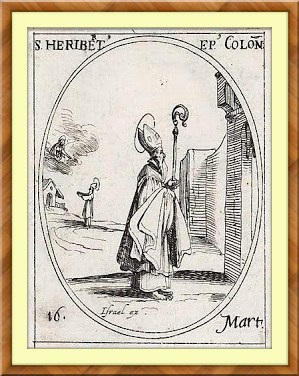
"It is not for the adornment of walls that alms exist, but for the relief of the living who are made in the image of God." — Saint Heribert of Cologne, to his critics
The Emperor's Most Trusted Man, and What He Did With the Trust
When Otto III died at Paterno in January 1002 — young, feverish, having dreamed of restoring the Roman Empire and found instead a short life and an early grave — it was Heribert who was at his bedside. It was Heribert who received the imperial insignia from the dying emperor's hands. It was Heribert who wrapped the body and organized the cortège that would carry it across the Alps to Aachen for burial. The most powerful ecclesiastical officer in the German kingdom — Chancellor of Italy and Germany, Archbishop of the most prestigious see in the Rhineland — became, in that moment, a man carrying his dead emperor home through the February cold.
The German princes were already maneuvering for the succession. When the future Henry II intercepted Heribert on the road and demanded the imperial insignia, Heribert surrendered them — the insignia were not his to keep — but refused to support Henry's candidacy immediately. Henry had him confined for a time. The tension lasted years. When Henry II was finally elected and Heribert acknowledged him, the reconciliation between the archbishop and the king was real but incomplete. It was not until 1021, the last year of Heribert's life, that Henry came to him — publicly, humbly — and asked pardon for his long mistrust.
Heribert accepted it. He died six weeks later.
He is not remembered primarily for the politics, though the politics shaped everything. He is remembered because of what he did with everything the politics gave him: the wealth, the position, the power of an archdiocese that was among the richest in the empire. He spent it on the poor. The critics who brought the complaint to the emperor — that the Archbishop of Cologne was allocating alms money that should have gone to church ornament — were not wrong about what he was doing. They were wrong about what mattered more.
Born at Worms, Formed at Gorze
He was born around 970 in Worms, the son of Duke Hugo of Worms — a nobleman of the Rhineland Franconia in the heart of the Holy Roman Empire. The world into which he was born was the world of the Ottonian dynasty: the German kings who had taken the Roman imperial title and were attempting, with considerable success, to run the largest political entity in western Europe as a synthesis of secular and sacred power.
His education began at the cathedral school of Worms, where he absorbed the Latin and theology expected of a future churchman. His father then arranged for him to stay as a guest at the famous Benedictine Abbey of Gorze, in Lorraine — one of the great centers of tenth-century monastic reform, where the Cluniac impulse toward rigorous observance had produced a community of exceptional quality. Heribert wanted to stay and enter the community permanently. His father recalled him. He returned to Worms as provost of the cathedral chapter, received ordination to the priesthood in 994 from the Bishop of Worms, and entered the imperial service the same year.
He was twenty-four. The emperor was nineteen. Otto III was the son of Theophanu, the Byzantine princess whose marriage to Otto II had introduced the culture and ceremonial of Constantinople into the German court, and who had governed as regent after her husband's early death with extraordinary competence. Her son combined the German drive for imperial universalism with Byzantine mysticism and a personality that his contemporaries found alternately brilliant and frustrating — a young man who wanted to be both Caesar and monk, who dreamed of a renovated Roman Empire with its capital at Rome, and who died at twenty-two having barely begun.
Heribert served Otto III as Italian Chancellor from 994 and as German Chancellor from 998. He was at the emperor's side in Rome in 996 and 997, in the years when Otto was making his most ambitious attempts to seat himself permanently in the Eternal City and govern the empire from there. He was with him at his death.
Archbishop and Almsgiver
He received the pallium from Pope Sylvester II at Benevento on July 9, 999, and was consecrated Archbishop of Cologne on Christmas Day of the same year. He was approximately twenty-nine years old. He would serve the see for twenty-two years.
The archdiocese of Cologne was vast, wealthy, and influential — the most prestigious in the German Church. Heribert administered it with the thoroughness of a man trained in imperial administration: he visited his parishes, organized his clergy, and attended to the practical management of the see's considerable properties. But what distinguished him from a merely competent bishop was the same quality that Gorze had planted and thirty years of court life had somehow not uprooted: the conviction that wealth was for giving.
He founded and generously endowed the Benedictine monastery and church of Deutz, on the east bank of the Rhine opposite Cologne. This was the foundation that would house his relics and remain the primary site of his veneration. He built it as a place of prayer and scholarship, not as a monument to himself. He served the poor of the archdiocese with a regularity and personal engagement that went well beyond formal almsgiving — he was known to divide his personal income directly among the needy, keeping nothing that could be spared.
The complaint to the emperor, that he was spending on alms what should have gone to the adornment of churches, is the crucial episode in understanding what he believed. His reply — that the living temple, the human being made in God's image, takes precedence over the stone temple — was not theological innovation. It was the straightforward application of what he had read in the Fathers, in the Sermon on the Mount, and in the example of the bishops and saints whose lives he had studied at Gorze. He applied it without qualification.
The Drought and the Procession
The miracle that earned Heribert his patronage against drought took place during a period of severe dry weather that threatened the harvest and the survival of the communities that depended on it. The sources record that Heribert organized a procession through the archdiocese — a liturgical petition for rain, with the people walking behind the cross and the relics of the saints toward the church of Saint Severin. He led the procession himself, praying openly and persistently for the intercession of God on behalf of his people.
The rain came. It came in such force that the sources describe it as a torrent — not merely adequate but overwhelming. The harvest was saved.
The account passed immediately into the hagiographical record. Heribert's grave at Deutz became a site of miracles from the day of his burial. Archbishop Pilgrim of Cologne, who succeeded him, called him a saint in a charter of 1032 — eleven years after his death, when the memory was still fresh and the miracles still accumulating. Pope Gregory VII confirmed the canonization between 1073 and 1075, less than thirty years before the first century of Heribert's death.
He died on March 16, 1021 — a Monday, in the holy season of the Church. He had served the Archdiocese of Cologne for twenty-two years, the German Church for his whole adult life, the poor of the Rhineland for as long as he had anything to give them, and the emperor — two emperors — with fidelity and care at every moment except the brief one when he hesitated over the succession, which cost him years of royal suspicion and which he never protested having paid.
His relics rest in the Church of Saint Heribert in Cologne-Deutz. The shrine — the Heribert Shrine, crafted in the late twelfth century, among the finest Romanesque goldsmiths' work in Germany — depicts him flanked by the personifications of charity and humility. Both of them are handing him his crosier. It is the Church saying, in gold and enamel, what it knows about the man: that his office was given to him by his virtues, not the other way around.
Prayer to Saint Heribert
O God, who gave to Saint Heribert the wealth of a great archdiocese and the wisdom to pour it out on the poor rather than the walls, grant through his intercession that those who hold power in the Church may hold it as stewards rather than owners, and that in times of drought — of rain, of faith, of mercy — we may have the courage to lead the procession and trust the prayer. Through Christ our Lord. Amen.
Saint Heribert, pray for us.
| Born | c. 970 — Worms, Rhineland, Holy Roman Empire |
| Died | March 16, 1021 — Cologne, Germany — natural death |
| Feast Day | March 16 |
| Order / Vocation | Secular clergy — Archbishop of Cologne (999–1021); Chancellor of Italy (994) and Germany (998) under Otto III |
| Canonized | c. 1073–1075 — Pope Saint Gregory VII |
| Body | Church of Saint Heribert, Cologne-Deutz; Heribert Shrine (c. 1160–1170), one of the finest Romanesque reliquaries in Europe |
| Patron of | Cologne · Deutz, Germany · Against drought · For rain and fruitful harvest |
| Known as | Heribert of Deutz · Archicancel of the Empire |
| Foundations | Benedictine Monastery and Church of Deutz, Cologne (founded and endowed by Heribert) |
| Their words | "It is not for the adornment of walls that alms exist, but for the relief of the living who are made in the image of God." |


